


I came across a great presentation by Goldman Sachs’ seasoned tobacco analyst, Bonnie Herzog. In it, she describes the state of the U.S. tobacco and nicotine market and its dynamics, with an outlook out to 2035. The presentation was for the National Association of Tobacco Outlets conference on 19 November 2025.
There are many fascinating charts with deep insights, but I really liked the following two slides:
1. An accelerated decline in smoking
First, an expected accelerating downward trend in combustibles (cigarettes + cigars) volumes, an 8.6% annual compound decline. For me, cumulative combustible product volumes are a reasonable proxy for the overall harm caused by smoking, though older people suffer more from each extra cigarette smoked. So that volume going down so sharply is great.
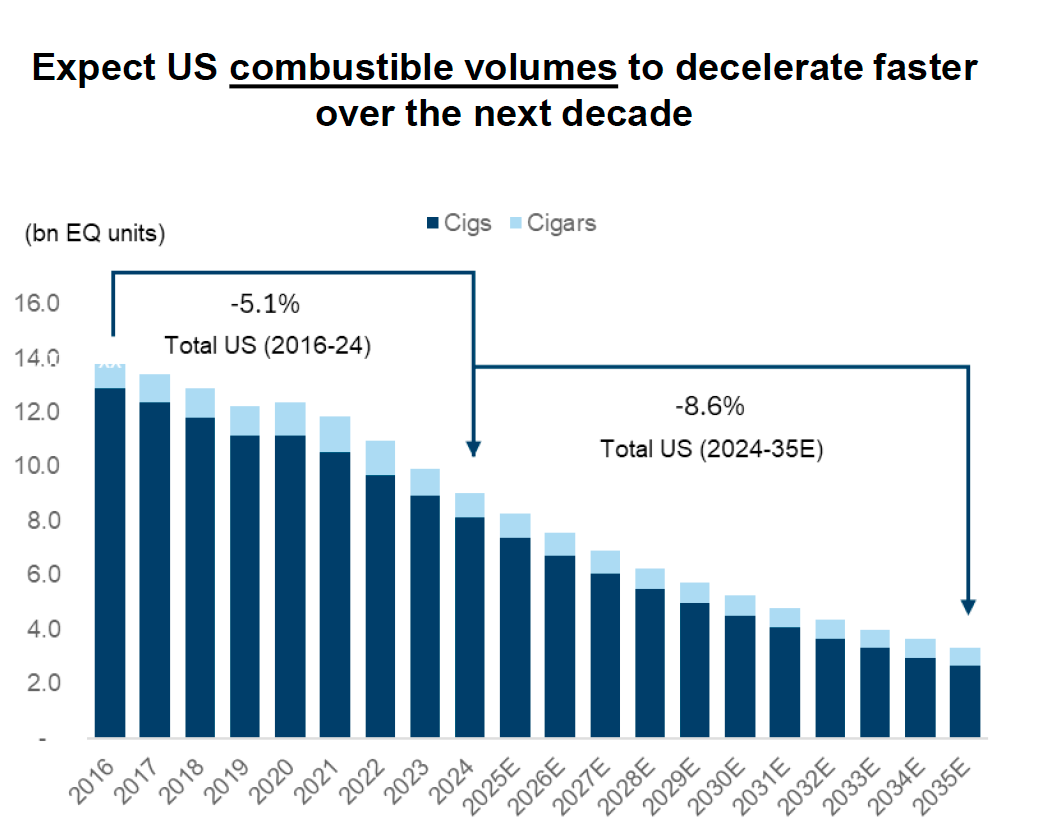
That’s about a 63% decline in combustible use between 2024 and 2035. But this does not happen in isolation. Note that cigarette dollar revenues don’t fall in anything like the same way, so don’t expect the rapid demise of Big Tobacco in these scenarios. Companies can raise prices and maintain revenues or attenuate declines.
2. A radical restructuring of the nicotine market
In the second chart I picked out, Goldman Sachs forecasts a major restructuring of the U.S. nicotine market, which is already underway. It is this, in my view, that allows the sustained decline in smoking (above), given the persistent demand for nicotine. The demand for nicotine is more resilient than any particular way of taking it.

In this forecast, there is only a small decline in total nicotine use (the outer envelope of the chart), and I guess that it is possible that total nicotine use may rise in some sensitivity analyses. How do you feel about that? Suppose it is the reason for the decline in smoking - how about that?
What can these charts tell us?
This outlook is achievable and would be a major win for public health, in my view. Yet I started thinking, “Is this realistic?” “What might be wrong here?” I can challenge all the assumptions in a picture like this and let scepticism kill all the optimism it inspired in me.
But I think there is another way we should approach it. Rather than ask, Will that happen?, perhaps we should ask, Do we want that to happen? How could it happen?
Here are some questions to help us examine our attitudes.
Is this scenario something we can all agree would be a good outcome? I think it would be a triumph, but I suspect many would see it as a defeat. Where do you stand? Why is there disagreement?
For public health, what really matters in that second chart? In my view, what counts is the trajectory of the cigarette and cigar bars (dark and light blue) because that’s the big harm and disease driver. Everything else is froth. For some, the outer envelope - nicotine use - has become the defining goal, regardless of what is inside it.
Rather than ask whether the forecast is correct (as if public health is a pointless bystander with no agency), we should ask how this trajectory could be achieved through public health policy, regulation, communications, and professional practice. What would cause this to happen in reality or even improve on these trends?
Who or what might hold back such developments? On what grounds and how? Is it the consumer, the companies, the regulators, the law-makers, or the nicotine-free diehards? What outcome would they hope to achieve instead and with what likelihood of success?
What about youth?
I imagine that some would say, “What about the youth?” Sure, but what about the older people? I want to end with a discussion of the age dimension.
Well, we should remember that the vast majority of those tobacco and nicotine products are consumed by adults (whether defined as over 18 or over 21), and the harm from combustion and smoke inhalation is likely one to two orders of magnitude greater than from smoke-free use.
For a report for the American Enterprise Institute, my friend and co-author Brad Rodu and I produced the following chart showing the number of users of U.S. tobacco and nicotine products:

There are vastly more adult consumers than youth for each category; these changes in market volumes primarily affect adults. This matters because older adults are the population at greatest immediate and long-term risk - and it is where we need to do better.
Three age-related considerations.
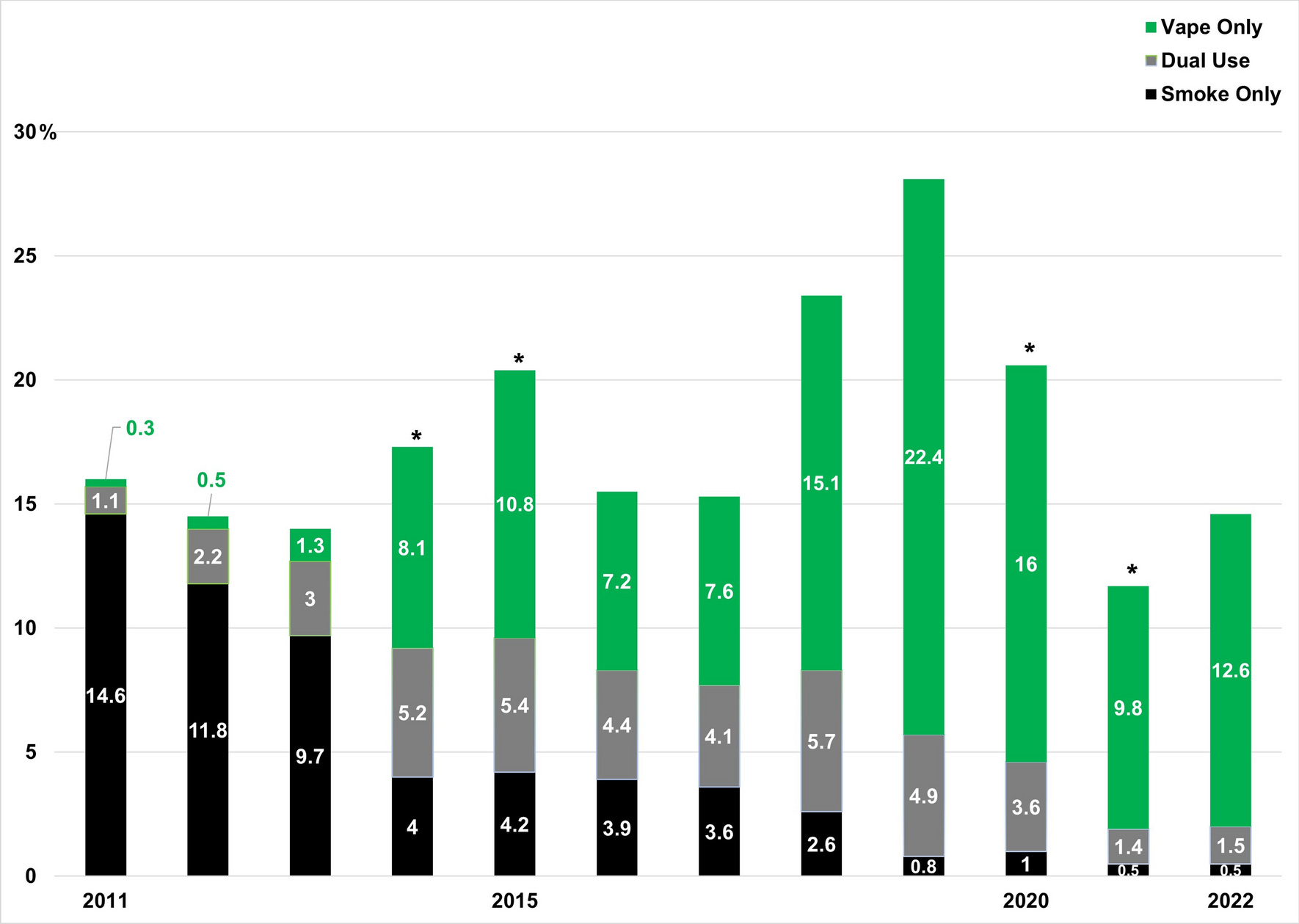
First, taking the win on youth smoking. Youth smoking in the United States is now at historically low levels and almost undetectable. The 2024 NYTS survey showed combustible use in the past 30 days among high school students at 3.3% and falling; see this great piece by Professor Ken Warner on the muted reaction: Kids No Longer Smoke Cigarettes. Why Aren’t We Celebrating? AJPH, 2025. It is likely that the substitution process portrayed in the second Goldman Sachs chart above is largely responsible for this, but with young people moving faster and earlier than the general adult population. For more on this, see Rodu and Plurphanswat, 2024, and the amazing graphic below - much like Goldman Sachs but ahead.
Second, refocusing on older smokers. There are traditionally three mechanisms by which smoking has declined: prevention, cessation, and death. The safer products add two more: diversion and switching. In the first of these, diversion, young people who would otherwise have smoked take up a smoke-free product instead: a giant win for public health, but rarely counted as such in politics or the media. These young people will age into the population and are unlikely ever to smoke other than as a niche habit, so they will drive down smoking rates as they age as adults. The real challenge is the slow rate of switching in the older population. See this paper by Mok et al. 2026 on trends in adult use segmented by age 2015-23. The chart below shows quite a sharp drop in 18-24, but only a very slow decline in 35-54 (and it is worse in older age groups).

This should be Public Health Priority No. 1: giving older adults the products, encouragement, and confidence to switch to smoke-free products. For more on this, see the brilliant Annie Kleykamp: Cigarette Use Among Older Adults: A Forgotten Population, AJPH, 2023.
Third, rethinking nicotine. If the nicotine-using envelope hardly shrinks or even increases, it will be with products that pose much less risk to health, and therefore much lower concern and far less reason for public health involvement. There is still the option to quit completely, as well as to switch to safer products within the smoke-free category (pouches and other oral products that do not involve heat or inhalation). I expect the nicotine market to expand because the main deterrent to nicotine use, the harms caused by smoking, is gone or greatly diminished. But that’s not something to worry too much about - it means that, from a societal point of view, nicotine is moving closer to caffeine in its impact and positioning (though the analogy should not be overstretched). If the outsized risks of smoking are far less of an issue, we can start to have a more sensible conversation about what people like about nicotine (without smoke) and why the demand for it is likely to persist, especially as the main deterrent to its use has gone. For more on this, see my briefing: Nicotine for Policymakers, 2025.
Conclusion
It’s not often I get to feel optimistic about the future. But Bonnie Herzog’s presentation was a reminder that consumers will ultimately pursue their own interests and preferences, and markets will adapt to allow them. The public’s health will prevail, even if Public Health tries to stop it. All the bogus science, misinformation, and ill-conceived regulations cannot stop the underlying economic forces. It will slow the migration to safer nicotine use, and cause needless suffering, but it will not stop the steady creative destruction of the cigarette trade coded into Goldman Sachs’ charts.
"we should ask how this trajectory could be achieved through public health policy".
All that is needed is public health changing it's policy to one of truthful, accurate information. All else is froth.
"consumers will ultimately pursue their own interests and preferences, and markets will adapt to allow them."
Or if one lives in Australia, the black market will adapt.
Of course, it would happen a lot sooner, and thus fewer people would suffer. The only change needed is to tell people the truth about relative risk. Everything else is set and will happen in time, like it or not.