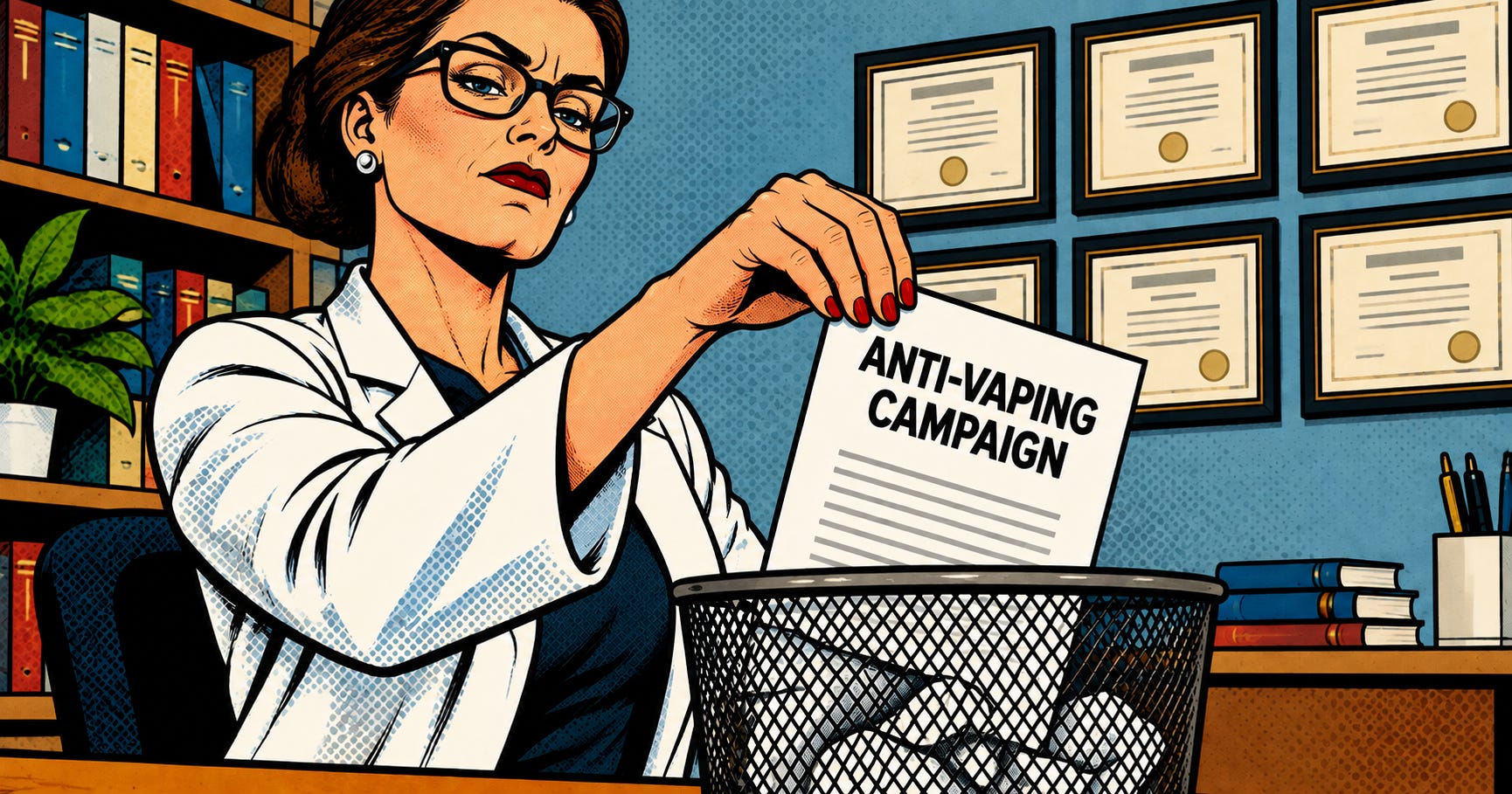
Action on Smoking and Health is nominally an anti-smoking group (it’s in the name) with targets to reduce smoking. Yet it now assertively supports anti-vaping measures, including new product restrictions, plain packaging, and display bans. This is on top of the eye-watering taxes, a ban on cheap, convenient disposables, and an advertising blackout. The package of anti-vaping measures is a bureaucratic Blitzkrieg of petty interference in consumer autonomy and harassment of pro-health businesses.
How will any of this help to reduce smoking?
A campaign letter to read but not sign
ASH’s latest campaigning initiative is a form letter, which I assume its allies and followers are supposed to endorse and sign, so that a letter with hundreds of signatures can be sent to the government. For interested readers, here is a link to the letter. You can, of course, sign up if you support the text of the letter. But do you support it?
I hope public health professionals and others will scrutinise the text carefully and decline to support the arguments in the letter and the policies it endorses.
The letter text is directly below. I will follow with some reasons for professional scepticism.
Open letter to the Secretary of State for Health and Social Care in support of proposals on tobacco, vape and nicotine product packaging, appearance and display
Dear Secretary of State,
We are writing to express our strong support for the Government’s proposals on the packaging, appearance and display of tobacco, vapes and other nicotine products. These measures are evidence-based, proportionate and essential for protecting children from tobacco and nicotine product marketing.
New data commissioned from YouGov by ASH during the consultation period shows strong public support for extending tobacco packaging laws. This data is currently under embargo and will be added when the letter is published.
Data from the annual ASH/YouGov Smokefree GB survey shows that the British public overwhelmingly supports further regulation of tobacco and vaping products:
Making Britain a country where no one smokes: 67% support vs 14% opposed.
Banning names of sweets, cartoons, and bright colours on vapes packaging: 79% support vs 5% opposed.
Banning child-appealing vape flavour names: 71% support vs 6% opposed.
The consultation rightly acknowledges that vaping is less harmful than smoking and can be effective in helping adult smokers quit. However, there is a clear and urgent need to reduce the appeal of vapes and other nicotine products to children.
We urge the Government to reject the coordinated efforts of tobacco and vape manufacturers to weaken these proposals and preserve their ability to market products to children. Tobacco companies have demonstrated that any loophole will be exploited for commercial gain, as with the introduction of menthol cigarillos following the ban on menthol cigarettes. We must not make the same mistake again.
The Government was given a clear mandate by both the electorate and Parliament to protect children from tobacco and nicotine products. The views of a vocal minority should not outweigh the overwhelming support for these measures among the public and health and education professionals.
We call on the Government to proceed with the proposals in full and send a clear message that public health, not industry interests, will determine the regulation of tobacco and nicotine products.
Reasons to reject this letter
These are things you may wish to consider before you commit your name or institution:
The dominant public health problem remains the millions of adults who have been smoking for more than a couple of decades - they are the ones getting sick, dropping out of the workforce, and creating health and social care costs - right now. For them, the benefits of switching are large (in quality-adjusted life-years, QALYs) and occur in the near future. The letter and government policy do not prioritise this aim. Yet it is the central aim of tobacco policy and coded into the government’s targets.
Instead, the letter and government policy stress youth vaping as the primary goal. However, they fail to recognise there are two kinds of youth vapers:
Those who benefit from vaping. Those who take up vaping but would otherwise take up smoking in the absence of vapes, or those who start smoking and switch later. About 10% of 16-17-year-olds smoke today, but could switch in future. These young people gain significantly from the youth vaping that ASH and the government are trying to stop. Vaping serves to displace smoking in young people; it is essential to understand this.
Those who don’t. Those who take up vaping but would never use nicotine products had vapes not been available. Given the relative risks of smoking and vaping, this group experiences a minor detriment (in QALYs), if any, and this emerges far into the future. Many in this group will stop vaping before there is any chance of significant risk. They are unlikely to take up smoking, given what we know of the gateway effect. And this is without counting any possible benefits arising from pleasure, mood modulation, cognitive enhancement, therapeutic effects, etc. We also have to consider nicotine use in proportion and in comparison with other youth risk behaviours, such as alcohol use.
If we take a public health view, rather than political talking points, there is not a simple “youth vaping problem” in which all youth vaping is unambiguously bad. For many youth, it has addressed the longstanding problem of smoking uptake. So when we talk about protecting youth, we must ask: Which youth? Whose kids? Protect from what? Might we make things worse? We are in public health, not politics, and we should think that way.
The public health problem and opportunity is heavily weighted to adults who smoke, and this should be the overriding emphasis of policy. Nothing should be done to degrade their opportunities and motivation to switch and quit smoking. The next most important opportunity is the elimination of smoking among young people. Displacing smoking to non-combustible nicotine use has been highly successful in achieving this in other countries. Finally, the group of new youth users that would never have used nicotine deserves protection, but not at the expense of the adult or youth smokers.
ASH uses the following formulation in its letter:
The consultation rightly acknowledges that vaping is less harmful than smoking and can be effective in helping adult smokers quit. However, there is a clear and urgent need to reduce the appeal of vapes and other nicotine products to children.
But this repeats the errors of the legislation and government policy: it pays lip service with empty words about the value to adults, while reserving all the energy and measures for the “urgent need” to protect children. The real urgent need is to help older smokers stop smoking by any means possible, and these measures and this letter work against that. Pay more attention to what is done than what is said.
Vaping is a substitute for smoking. Anti-vaping measures are likely to increase smoking via a variety of mechanisms (relapse, reduced switching, reduced diversion at initiation, persistent dual use). Extensive economic evidence supports this. How has this been reflected in the reasoning that supports this letter?
There is a strong and rising illicit vape market in the UK and Europe. Shamefully, there is no official estimate of the illicit share of the UK vaping market, but industry and other estimates commonly converge at around 30%. I expect the Vape Duty to significantly increase the illicit share, and these anti-vaping measures to further reinforce illicit commerce. How has criminalisation of supply been integrated into the reasoning? What are the effects on youth of exposure to criminal networks?
The letter quotes a public opinion survey: “Making Britain a country where no one smokes: 67% support vs 14% opposed. I assume this is included to endorse the Smoke-free Generation measure, the fool’s gold of tobacco control. This measure will, at best, have second-order effects on smoking, and take decades to achieve anything at all, if it ever does. In reality, a smoke-free Britain will be reached through migration of the persistent and likely permanent consumer nicotine market from smoking products to smoke-free products, including through uptake of vaping instead of smoking by young people. There are no good arguments for obstructing or slowing this inevitable transition. There are no arguments for assuming the nicotine demand will disappear, and no one would even try to claim that for alcohol.
The letter again complains about other stakeholders having a say, referring to “a vocal minority” expressing their views. They ignore the millions of consumers and small businesses who have a real stake in these decisions - see my posting on this aloof attitude.
The letter predictably projects the tobacco industry as the bad guys. It’s a very unoriginal way to dismiss unwanted ideas without going to the trouble of making an argument. But what do the companies want? They aren’t pushing cigarettes; they want to sell safer alternatives to cigarettes - and to the far larger adult market (there are at least 15 adult nicotine users for every youth user in Britain). The letter uses an argument about menthol cigarillos replacing the menthol cigarettes when the latter were banned. The key difference is that these regulations apply to products that, beyond any reasonable doubt, are far safer than smoking. The same is not true for cigarillos; the comparison is misleading, and many other factors come into play when regulating safer alternatives.
The letter places great emphasis on the force of public opinion. Yet public opinion is an unreliable guide to what works and what goes wrong. How would members of the public know enough about nicotine use, social determinants and risk factors, and market behaviours to offer sound advice? They may know what they want, but not the consequences of trying to get it. That is why we have professionals paid to understand evidence, design regulation and markets, and anticipate unintended consequences. Public interest groups can only show public value by basing their case on dispassionate analysis, not by joining a mob whipped up into a moral panic. If you work in public health, you should be able to do a bit better than a random sample of poorly informed public opinion answering loaded questions.

As you can probably tell, I do not think these measures are “evidence-based, proportionate”. This is because they have not adequately considered the effects of anti-vaping measures on smoking, have not defined the target population correctly, and have misconceptualised youth vaping. I do not think they are “essential for protecting children from tobacco and nicotine product marketing” because adolescents are not the right target, and that is not the right goal.
I have concentrated above on vapes, but similar arguments apply to nicotine pouches, heated tobacco and snus - and any form of non-combustible consumer nicotine products.
What should be done instead?
Am I arguing that nothing should be done and everything is already perfect? No, I think there is scope to do better. But the efforts to do better should not do more harm than good.
Here are some suggestions:
Smoking. Above all, focus on reducing smoking. Most of what can be done on smoking itself has been done, or risks building illicit markets. The main missing public health strategy is persuading and incentivising people who smoke (at any age) to switch to the full range of smoke-free alternatives, including pouches, vapes, heated tobacco and snus. Above all, the government should make a concerted effort to correct relative risk perceptions, in which 54% of British adults now believe vaping is as harmful or more harmful than smoking - a catastrophic failure of public health risk communication. Almost everything the government has been doing recently works against this (it needs to regain the spirit of Swap to Stop). It’s not as if there are no ideas to take this agenda further: see these 20 proposals from the New Nicotine Alliance from 2022. Of course, much of this has been ignored in favour of anti-vaping measures.
Licensing. Retail licensing will diffuse much of the bad practice on vaping that rightly drives the public mad - it should lead to a real crackdown on seedy shops selling sweets and vapes, while also tackling money laundering and tax evasion. A robust but proportionate licensing system should put an end to the dodgy vape shops.
Packaging. There should be restrictions on branding and packaging that appeal to youth (cartoons, trademarks, graphics, etc.) These could follow the same principles previously identified in restrictions on advertising [CAP Code section 22]. There is no case for plain packaging, and this will create an inherently misleading risk communication suggesting equivalence with cigarettes. The evidence supporting plain packaging for vapes is risibly weak and tainted with activist involvement, yet there are obvious reasons to be concerned about implicit risk miscommunication.
Flavours. There should be limits on flavour descriptors, again adopting the principled restrictions that previously applied to advertising, avoiding frivolous flavour names or trademarks. However, descriptors must accurately describe the contents and no more - that is consistent with consumer protection law [see Consumer Rights Act (2015) S.11] that requires products to be as described. There is no case for imposing misleading single-word descriptions. A commendable strength of UK regulations is their focus on descriptors rather than banning characterising flavours per se. They just need to moderate their language to reflect the consumers’ interests and rights.
Display. These products should not be displayed in shop windows or be prominently visible from outside. But they should be accessible and visible inside shops so people can look at and understand them. We need smokers to see the alternatives and become curious and attracted. We need retailers to take the initiative and encourage people to buy these products instead of cigarettes. We do not lock away alcohol, which is far more dangerous to young people. Locking away both cigarettes and vapes is another form of implicit risk communication. Display restrictions can be built into license conditions that are applicable to the premises.
Gimmicks. There is no place for games and video consoles or designs that look like hand grenades or sex toys. These are highly unusual, rarely seen in conventional retail settings, but would likely remain available in niche corners of the internet. Nevertheless, the law should make clear that they are unacceptable and unlawful.
Leaflets. NHS-branded leaflets could be required in cigarette packs that encourage people to quit or switch to smoke-free alternatives. In fact, the government’s proposed leafleting is to go into safer nicotine products to warn of the dangers of nicotine, a continuation of an EU policy that demands a rethink.
Product information on and inside vaping and nicotine products packaging
[…]
Where applicable, we propose that certain products have an instruction leaflet to inform users of any appropriate warnings and the adverse effects of nicotine. [source]
Again, these actions focus on the safer alternatives. No leaflets will be included in cigarette packs. The opportunity is wasted because the government and its supporters are focused on the wrong things.
Heated tobacco. The government and ASH need to stop treating heated tobacco products (HTPs) as if they are equivalent to cigarettes and therefore should be treated with similar policy. The key distinction for policymakers is not between tobacco and non-tobacco; it is between combustion and non-combustion. HTPs likely reach a different type of adult smoker and may work for switching for different people at different times in transition. These products should be bracketed in the same category as vapes (they are a form of vape), not least because they are “appropriate for the protection of public health” and “modified risk tobacco products” by the world’s most pedantic regulator, the U.S. Food and Drug Administration.
Consumers. Consumers are the most directly affected stakeholders by the policy decisions on tobacco and nicotine. (See: Stakeholders without a stake for a discussion of stakeholder legitimacy). The consumers’ organisation, the New Nicotine Alliance, is encouraging its members to respond authentically to the consultation (they are not using a sign-up letter) and contact MPs, using its guidance to assess the various proposals. See the NNA website, Saving Vaping, to understand the consumer perspective. Should you really sign a letter from a tobacco control group without first understanding what those directly affected believe should be done and why they disagree?
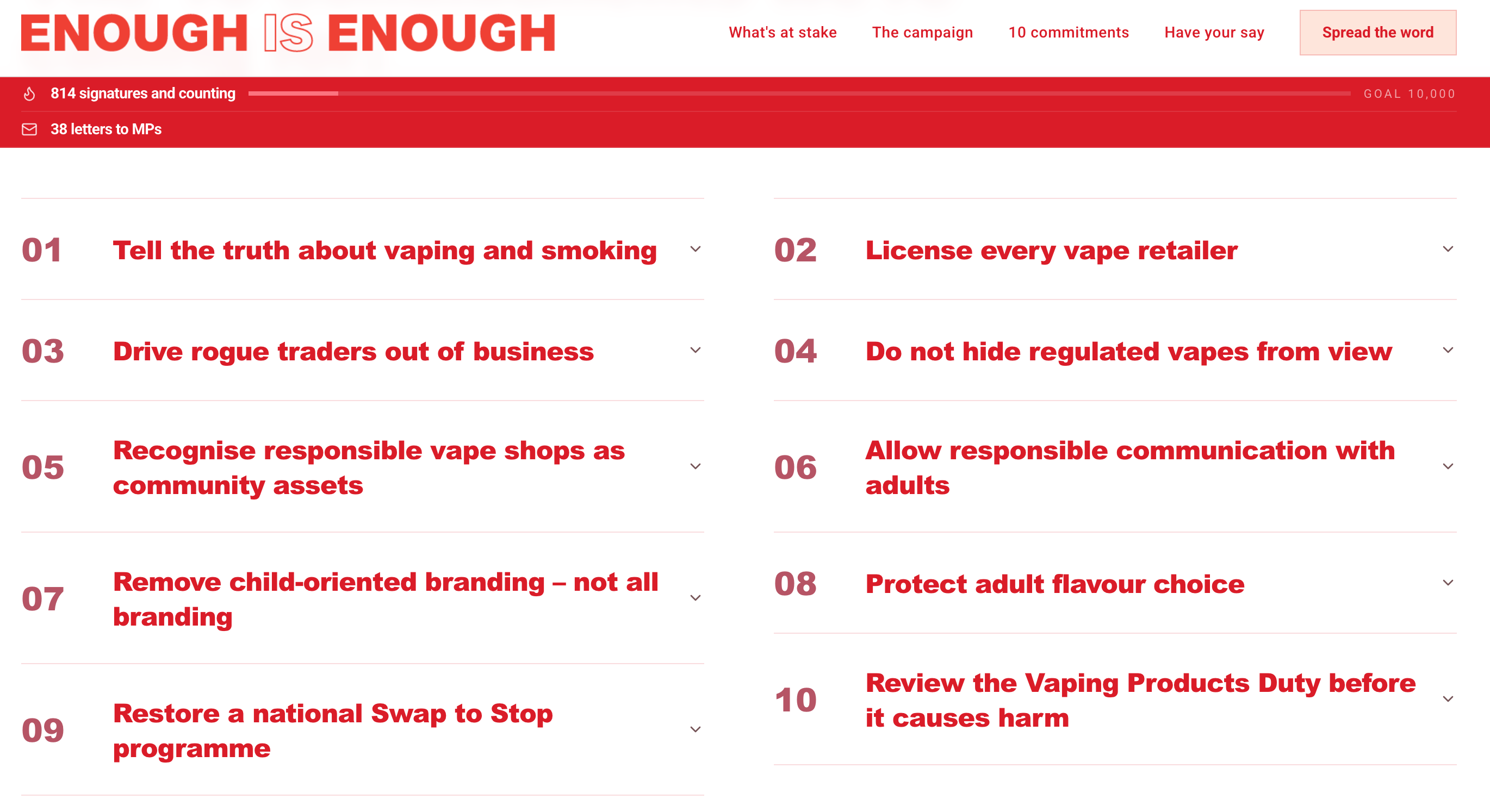
Industry. At the very least, everyone should take seriously the “Enough is Enough” campaign of the responsible vape industry (UKVIA), which is reeling under the government’s sustained anti-vaping assault on one side, and burgeoning illicit trade on the other. UKVIA has proposed some workable, proportionate controls. Public health or other professionals should consider these views before committing to sign anything.
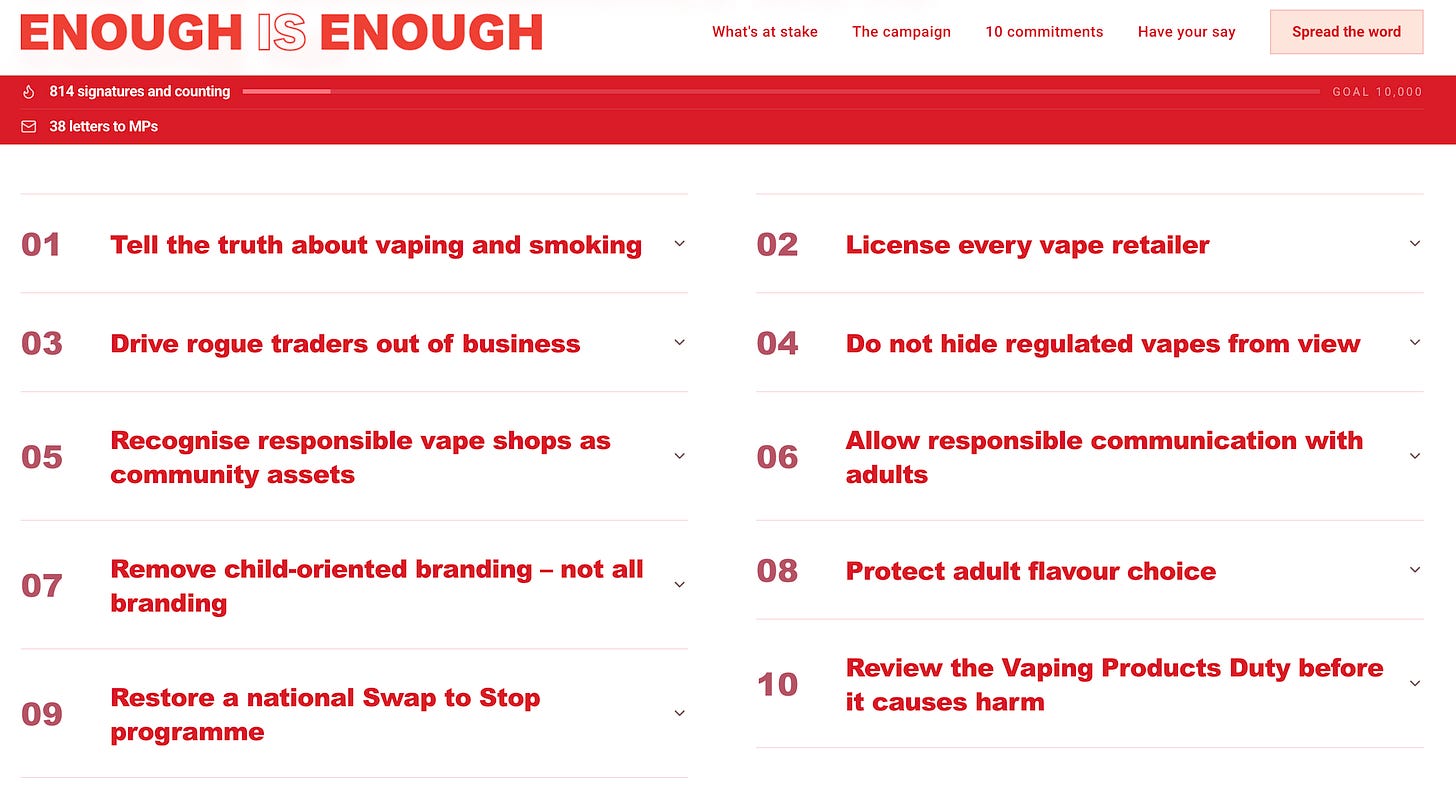
If you want to sign anything, I’d consider signing up to the Enough is Enough campaign; the link is here. For me, this works for public health and good commercial policy.