


Taking human life and suffering seriously
I’m often asked, “What’s the point of working on tobacco harm reduction?” or “Why are you so bothered about vaping?” Would I be wrong to say that there is nothing else with quite so many lives - and deaths - at stake? For public health, it is an unusually tractable problem: the right decisions could perhaps prevent 100 million deaths in the present century, but the wrong decisions would do the opposite. It is a cause worth fighting for, but the forces ranged against rational pragmatism are formidable, well-funded, and unaccountable.
One of the strangest things about public health, and especially tobacco control, is the disconnect between incentives (employment, pay, grants, personal prestige) and the nominal outcomes (avoiding needless death and suffering). Fair enough, it is quite hard to link cause and effect, and the results may lag the actions by years or decades. However, this doesn’t preclude the use of proxy measures of outcomes, such as changes in risk behaviours, such as smoking.
Strategy to prevent 100 million deaths
So let’s imagine a new WHO Director General began to take the organisation’s mission (to “promote health, keep the world safe, and serve the vulnerable”) seriously and decided to pay its staff for results. Panicked tobacco control bureaucrats, fearing penury and destitution, engage us as strategy consultants. Our assignment is to propose a clear-eyed, unemotional, and results-driven approach to reducing the human health, social, economic, and environmental consequences of tobacco and nicotine use (a goal that aligns with the objective of the Framework Convention on Tobacco Control at Article 3).
What would we advise? We analyse the options via a series of probing questions.
First, how do we define and quantify the problem?
In 2023, around 1.1 billion people smoked about 5 trillion cigarettes. According to the Global Burden of Disease study, worldwide, 7.4 million died from smoking-related disease, and 203 million disability adjusted life-years were lost. The number of people who smoke is increasing as increases in population outpace declines in smoking prevalence.

On top of the burden of mortality, millions more lived in misery with cancer, cardiovascular disease and respiratory conditions. On top of this, there are further harms caused by the policy response, such as regressive taxes, stigmatising campaigns, and restrictions on smoking. These policies might be justified to reduce disease and protect non-smokers, but they add to the burden for people who continue to smoke. The problem is overwhelmingly caused by smoking tobacco and secondhand smoke – inhaling products of tobacco combustion – and not directly by the use of the drug nicotine, and the toll is rising as users age.

The harms are dominated by human health costs (in terms of lost life and quality-adjusted life years). Much of the social, economic and environmental harm flows from these health impacts, the policies to address the health impacts, and unintended consequences arising from policies to address health impacts of smoking. Smoking remains the critical public health problem - at least one we can do something about.
Second, why does this problem persist?
If it causes so much harm, surely it is just a matter of informing people and helping them to act in their own interests? That is basically true, but what information and what help? This seemed like the obvious answer to the anti-smoking pioneers of the ‘60s onwards. Doctors would educate people on the risks, people who smoke would reassess their interests, and they would stop smoking or never start. Some analysts suggest that this may be the dominant or even only anti-smoking strategy that has ever worked, but it has been painfully slow.
Our working theory is that the underlying demand for the recreational drug nicotine is robust and its rewards potentially dependence-forming. We determine that for some people, nicotine use may be appealing for its mood control, cognitive advantages, and pleasurable sensations, and this underpins the demand. We note the long lag between the positive reinforcing experience of smoking and the most severe health effects, and how people tend to devalue, or discount, negative impacts far in the future compared to gratification today. But if we can separate the experience of using nicotine from the harms of using it by smoking, then there may be a way around this.
Third, what is wrong with what we are already doing?
Perhaps it is a matter of allowing the standard tobacco policy toolkit, “MPOWER”, to work across multiple countries and several generations. Yet, despite fifty years of concerted action, we still have about one in five adults smoking worldwide and the number of people smoking continues to rise as population growth outpaces declines in smoking prevalence (see Global Burden of Disease study).
Now that 80 per cent of the world’s smokers are in low- and middle-income countries, we ask if the intense and sustained regulatory, fiscal, and campaign focus necessary to drive down smoking and nicotine use is viable and sustainable in these countries, especially given the rise of illicit markets.

Fourth, can we go further with the established measures?
The problem with pulling harder on the existing levers is that we may encounter barriers to public consent and political acceptability (politicians are only willing to be tough with voters up to a point), or we may see escalating unintended secondary consequences. For example, very high tobacco taxes are regressive, inflicting financial pain on households, and likely to trigger black markets or adverse behavioural responses. The public may view workplace smoking bans as acceptable to protect workers, but would they feel the same about banning smoking outdoors? We might push harder with enforcement and punishment, but the danger is that such measures may be illiberal, excessive, or unfair; we may run up against practical and ethical limits on the acceptability of intrusive tobacco-control measures (Lund & Saebo, 2024). What about escalating and just banning cigarettes or forcing manufacturers to remove the nicotine? After all, if that is the problem, why not take the most direct way to address it? Again, we run into difficulties of public consent, political appetite and perverse unintended consequences that are all too foreseeable given the experience with drug and alcohol prohibitions.
Fifth, what innovative options are available to expedite progress?
Yes, there are incremental improvements in smoking cessation treatments, like Cystisine, and these are welcome. Results data is not always kind to tobacco control orthodoxy: for example, Turkey scores top marks for MPOWER measures, but Turkey’s smoking rates are high and rising (Sönmez, 2025). To save 100 million lives and do this quickly, there needs to be a game-changer. If the underlying demand is for the experience of using nicotine and the harm is caused by the use of nicotine by smoking and inhaling products of combustion, then there is an obvious path forward. Our key strategy advice is to do everything possible to migrate the nicotine market from the dangerous smoking products to the much safer smoke-free products, for which estimates suggest there are already more than 140 million users. There are two reasons to adopt this strategy.
First, it provides a relatively simple way for existing smokers to switch to products that eliminate nearly all the additional risks of continued smoking. When someone who smokes switches, they do not have to give up the nicotine, the sensory (taste, throat hit) experience, or much of the behavioural ritual. The barrier to stopping smoking is far lower if you do not also have to quit nicotine.
Second, these products provide low-risk alternatives available to people who will use nicotine in future (whether we like it or not) without ever starting to smoke. This second function is essential because we do not believe it will be possible to stop future nicotine use (or desirable to try) any more than we could wind down the use of caffeine, alcohol or cannabis. There will be new users; they require the option of far safer products.
To the extent we have managed to reduce overall demand for nicotine, it is mainly on the back of messaging and measures to address the harm caused by smoking. But it is that harm we are trying to eliminate. We have seen how this can work in Sweden. Germany and Sweden have had roughly similar nicotine use, but Sweden has about half the lung and oral cancer rate in men because far more of the nicotine use is in the form of smoke-free oral tobacco. The global map of nicotine use resembles Germany, but it could evolve to resemble Sweden.
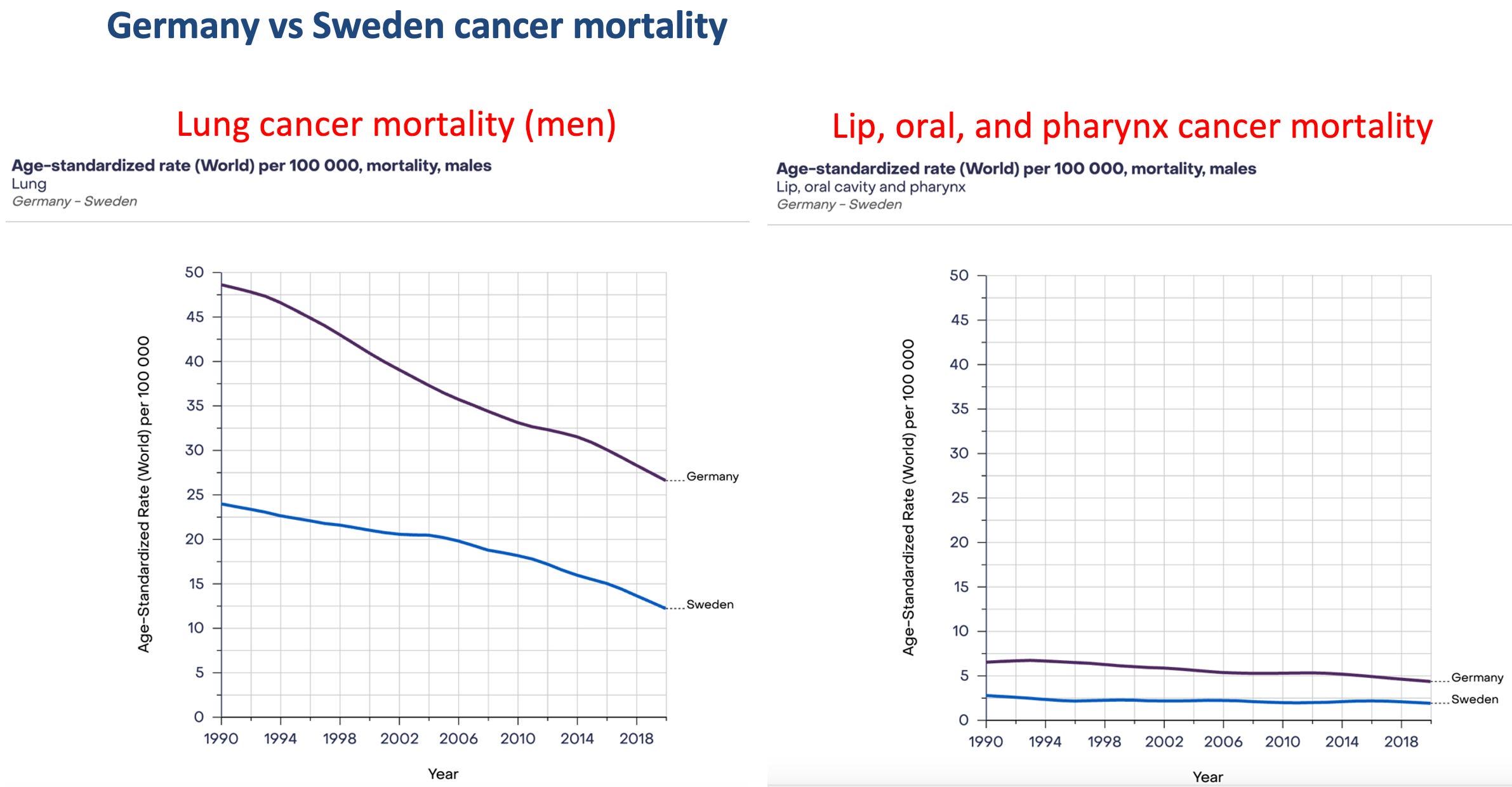
We use lung cancer here because it is the most directly and exclusively connected to smoking.
Sixth, how could we expedite progress?
Here we will rely on what the economist Joseph Schumpeter termed a “gale of creative destruction“ or the “process of industrial mutation that continuously revolutionises the economic structure from within, incessantly destroying the old one, incessantly creating a new one“. That sounds neat: should we simply wait for this process to run its course? Of course, not. Five critical contextual pressures will expedite the inevitable creative destruction of the cigarette market. The right strategy for the WHO and for government, civil society, and business is to shape these incentives to expedite the obsolescence of smoking to create a viable low-risk nicotine market with acceptable risks:
The information environment: What do people believe about smoking and the alternatives? What do trusted professionals and organisations say and advise? What do newspapers report, and how reliably do scientists communicate their findings in scientific papers and press releases? A significant tobacco control effort has been made to engineer misperceptions about relative risk and to dissuade smokers who would switch from making that move. The information environment is highly contaminated with harmful misinformation.
The practitioner environment: what do healthcare professionals and public health agencies do and say? Do they encourage and assist with switching from smoking to low-risk alternatives and give good advice about risks? Or do they insist on complete abstinence? Are they approaching tobacco harm reduction as a last resort once everything else has failed? Or do they see the scope to move quickly to mitigate risks? Are they interested in the preferences of the people at risk, or just impatient with them?
The regulatory environment: Regulations can encourage consumers to move from high-risk to low-risk products - an approach we know as ‘risk-proportionate regulation’. However, the regulatory landscape for cigarette alternatives is dominated by anti-proportionate regulation: prohibitions and stealth prohibitions, including outright bans, bans on flavours, limits on nicotine levels, advertising bans and so on. Again, the current trends protect the cigarette trade and work against the goal.
The fiscal environment: The tax system can create incentives for consumers, retailers and manufacturers to favour low-risk smoke-free alternatives over high-risk cigarettes. But we now see persistent calls to raise taxes on vaping and heated tobacco products to equivalent levels to cigarettes. Again, the current direction is anti-proportionate with respect to taxation. Taxation levels close to smoking products are common, even though risks may be one to two orders of magnitude lower.
The innovation environment: How favourable are the market conditions to the emergence of improved products and new entrant firms? Better products will be necessary to meet the needs of the most committed smokers. Is the market competitive, or does oligopoly create barriers to entry and innovation? Does it require massive regulatory costs and delays to bring a product to market (e.g., the U.S. Food and Drug Administration)? Can innovators communicate with consumers to explain their innovations, or are such communications prohibited by advertising and other commercial regulations? Does innovation focus on improving the customer experience relative to cigarettes, or is it primarily directed toward regulatory compliance that does little for product users?
Taking responsibility for results
This incentive framework, consistently applied, will fundamentally change the nicotine market for the better, potentially destroying some companies but making giants of others. A determined goal-driven strategist would shape these five environments to harness market dynamics for public health.
That will mean challenging those who purport to represent public health interests while doing all they can to delay the market-based obsolescence of cigarettes. They may slow a necessary and inevitable transformation and cost thousands of lives, but they will not stop it.
The bureaucrats at WHO, attending COP meetings, and advising governments worldwide ought to behave as if their own lives depended on getting this right, because the lives of many others depend on it. I estimate about 1,000 people attended the recent FCTC meeting in some sort of official capacity, so that’s roughly one million people worldwide who smoke for every tobacco control bureaucrat. Even if you assume approximately 20,000 people are professionally engaged in tobacco control worldwide (government, academia, activism, healthcare), this still yields a ratio of approximately 50,000:1.
With such awesome responsibility, there ought to be more accountability.
This post is a revised and updated version of an article I published in Tobacco Reporter in 2022.